
What Scaling Really Looks Like in 2026: Lessons from a Fintech Founder
Scaling a business is often talked about in terms of growth - revenue, headcount and funding rounds.
But behind the scenes, the reality is far more complex.
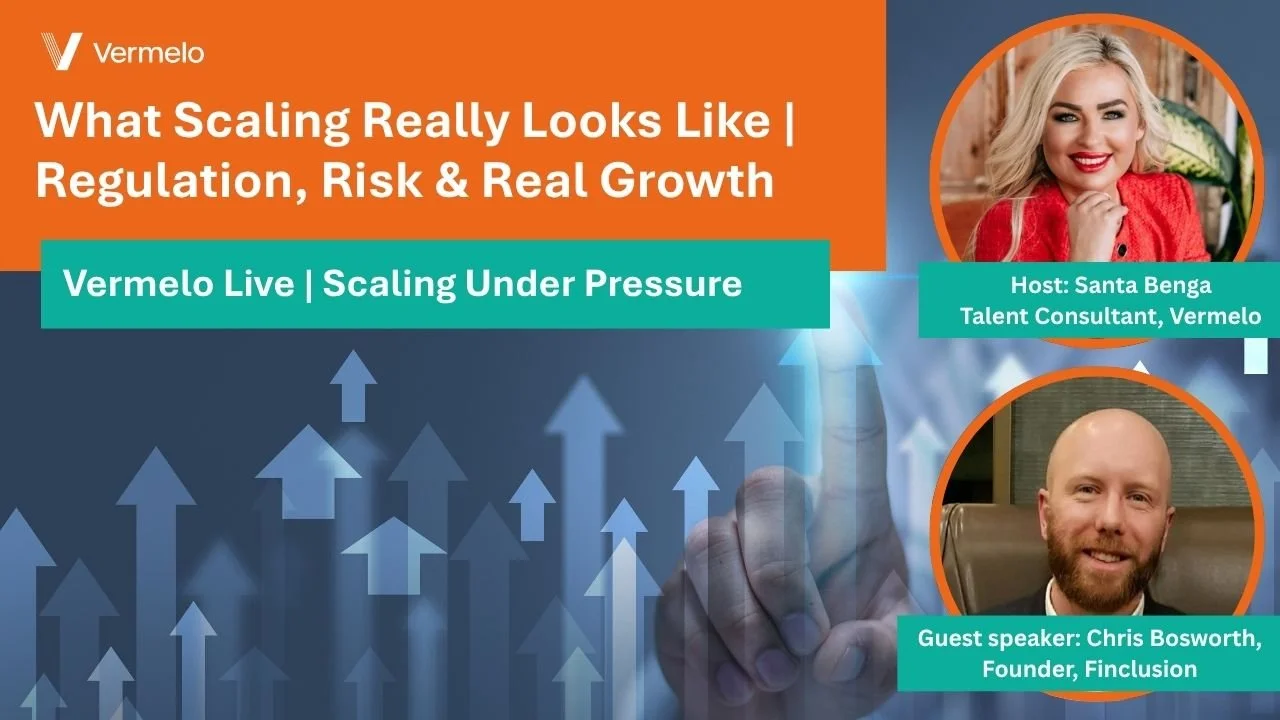
In a recent Vermelo LinkedIn Live – Scaling Under Pressure, Chris Bosworth, Founder of Finclusion, shared a candid view of what scaling actually looks like, from hiring and leadership challenges to operating in regulated markets.
Scaling Isn’t Just Growth: It’s Managing Complexity
Chris is currently building Finclusion, a fintech focused on providing motor finance to underserved customers - a segment often overlooked by traditional lenders.
But while the product is specific, the lessons on scaling are widely applicable.
At its core, scaling is less about acceleration and more about managing increasing complexity.
As Chris explains: “As you get bigger, you become more reliant on processes and less reliant on relationships.”
In the early stages, teams are small, communication is direct and decisions happen quickly. But as headcount increases, informal ways of working begin to break down and structure becomes unavoidable.
What Breaks First When a Company Scales?
One of the most useful themes in the conversation was a simple question: what actually breaks first during scaling?
Chris’s answer was process. Not because process exists and fails, but because in early-stage businesses it often isn’t built for scale in the first place. As he put it,
“In the early stages the process is by its nature broken.”
As businesses grow, those processes have to become “more and more robust” and increasingly non-negotiable.
As companies scale, they are forced to move:
from informal communication to structured reporting
from flexibility to repeatability
from person-to-person judgment to systems and management layers.
That shift is necessary, but rarely seamless.
The Hidden Cost of Growth: Why More People Doesn’t Mean More Output
One of the strongest insights from the discussion challenges a common assumption in scale-ups: More hires do not automatically mean more productivity.
Chris points out that once businesses grow beyond a certain point, each additional hire can actually reduce productivity in the short term because more management, more process and more coordination are required.
His line on this is especially sharp:
“Everyone thinks that if I’ve got 50 heads and I hire another 50, I’ll be twice as productive. But that really isn’t how it works.”
He goes even further:
“To go from 50 to 100, you’ve actually got to go from 50 to 150 to double your capacity.”
It is one of the biggest pain points in scaling and one many founders only understand once they’ve already hit it.
Why Staying Lean Is a Strategic Advantage
One of the clearest choices Chris and his co-founders have made at Finclusion is to stay deliberately lean.
Rather than building a large team for optics or investor signalling, they are focused on building a business that is efficient, productive and commercially disciplined. As Chris put it:
“We’re trying to be efficient and profitable and productive rather than just big for the sake of being big.”
That same thinking applies to how the business is built. Not everything needs to be owned internally. One of the more practical points in the conversation was around being clear on what sits within your real area of expertise and outsourcing what doesn’t.
Chris summed that up neatly:
“A lot of those things you build from scratch, probably, you’ve just reinvented a wheel you didn’t really need to reinvent.”
For scale-ups, that is an important reminder:
focus on the core differentiators
use external expertise where appropriate
avoid unnecessary complexity too early.
Hiring Challenges: When Growth Forces Process
Hiring is another area where scaling changes everything.
In smaller businesses, hiring is often consensus-led. Founders and senior people stay closely involved and strong performers tend to recognise other strong performers quickly. But as businesses grow, hiring becomes more formalised and can often be less effective.
Chris described this as the point where hiring becomes “mechanised” and said that is when problems often begin.
That shift matters because hiring decisions move further away from the people who have built the business and understand the quality bar best. At the same time, founders face another challenge: knowing when to hire at all.
One of the most practical takeaways from the conversation was:
“The hardest part is recognising when you have a capability gap and when the business is at a size where it can’t tolerate that gap anymore.”
That tension, staying lean while filling real expertise gaps, is one of the hardest balancing acts in any growth business.
Scaling in Regulated Markets: Constraint or Advantage?
Operating in a regulated market clearly adds pressure. It requires more robust process, more documentation and a stronger control framework from the outset. Chris was clear that, in a regulated business, you cannot simply rely on trust and informal working in the same way.
But one of the more interesting parts of the discussion was that he does not see regulation purely as a drag on growth.
In fact, his view is almost the opposite:
“In a weird way regulation can actually help… it gives you a moat.”
That is a useful challenge to the usual narrative. In regulated sectors, compliance can create barriers to entry, sharpen focus and help businesses innovate within clearer boundaries.
The real tension is usually not compliance but risk. Chris explained that early-stage businesses often have to moderate growth while proving that their models work even when the team is eager to move faster.
That discipline may feel frustrating in the short term, but it is often essential to building something sustainable.
Leadership: From Doing to Letting Go
Scaling also changes leadership.
In the earliest stages, founders are deeply involved in everything, wearing many different hats. As businesses grow, that becomes impossible - but knowing what to let go of, and when, is not straightforward.
Chris captured that well when he described the journey as starting with “100 hats” and gradually having to work out how to shed most of them.
He also made an unusually honest point about leadership: sometimes the biggest shift is recognising where your strengths end. That self-awareness matters because scaling often depends less on doing more yourself and more on knowing when the business now needs different capability around you.
A useful founder question, as he put it, is:
“Am I the best person to be doing this particular task or not?”
Define Success Goals Early
One of the most valuable lessons from the conversation was not operational at all, it was personal.
Chris reflected on how easy it is for founders to judge themselves on what are, in reality, vanity metrics: headcount, revenue, valuation and external perception.
But those measures only matter if they align with what the founder is actually trying to build.
His advice was simple: define what success means to you early, before the noise of scaling takes over. For some people that may be valuation. For others it may be ownership, sustainability, or simply building a business that gives them more control over how they live and work.
That clarity matters, because the choices made during scaling will always reflect the goals underneath them.
Watch the conversation in full
This article captures some of the main themes from the LinkedIn Live, but not the full discussion. To hear the complete conversation, including Chris’s insights on hiring, leadership, regulation and the practical reality of growth:
Vermelo is a UK talent solutions specialist delivering RPO, Project RPO, MSP, embedded talent (RaaS), total talent and talent advisory & consultancy. Named Best Recruitment Process Outsourcing (RPO) Business at the Global Recruiter Awards 2025. Part of the GWV Talent Solutions Group which includes Gerrard White Consulting and FlarePeople.