
Agencies vs in-house is a false hiring choice
For years, growing businesses have been told they have two options when it comes to hiring:
Build an internal recruitment team
Outsource to a recruitment agency
But for many mid-sized companies, neither option fully works.
Internal teams can struggle with sudden spikes in hiring demand, specialist hiring requirements, or rapid scaling periods. Traditional agencies can move quickly, but often operate at arm’s length from the business, creating inconsistent candidate experiences and high placement costs.
The reality is that the “agency vs in-house” debate is outdated.
A modern embedded recruitment service offers a third option: a flexible recruitment model that combines the speed and expertise of agency hiring with the alignment and brand immersion of an internal talent team.
For founders and talent leaders focused on scaling teams and hiring efficiently, embedded recruitment is increasingly becoming the fastest, most scalable approach.
Below we’ll cover:
Why the traditional hiring model is broken for mid-sized companies
What an embedded recruiter actually does
Why flexible recruitment models outperform rigid hiring structures
The six questions every business should ask before choosing a recruitment partner
Why mid-sized company recruiting has changed
Hiring challenges for mid-sized businesses look very different today than they did five years ago. Most growing companies are now balancing:
Faster growth expectations
Competitive talent markets
Leaner operational structures
Increased pressure on hiring managers
Employer brand expectations
The need for specialist and niche hiring
At the same time, many businesses are caught between two ineffective extremes.
(1) The problem with relying purely on recruitment agencies
Traditional agencies can be useful when speed matters. But for many businesses, the model creates long-term inefficiencies.
Common frustrations include:
High fees per placement
Limited understanding of company culture
Multiple agencies competing on the same role
Poor candidate experience consistency
Short-term hiring focus instead of workforce planning
Minimal integration with internal stakeholders
Agencies are often incentivised by transactions, not outcomes.
Many organisations are now exploring alternatives to traditional recruitment agencies that offer greater flexibility and long-term alignment.
(2) The problem with building entirely in-house
Building a full internal talent acquisition team sounds attractive, but it comes with its own challenges.
Many mid-sized company recruiting teams experience:
Long hiring lead times
Limited specialist expertise
Difficulty scaling during growth periods
High fixed recruitment costs
Underutilised internal recruiters during slower periods
Delays caused by limited sourcing bandwidth
An in-house function can work well at enterprise scale, but many mid-sized businesses need something more agile.
That’s where embedded recruitment services have become increasingly valuable.
What is an embedded recruitment service?
An embedded recruitment service places recruiters directly into your business, operating as an extension of your internal team.
Unlike traditional agencies, embedded recruiters work inside your hiring processes, align with your employer brand, collaborate with hiring managers, and focus on long-term recruitment outcomes.
Unlike permanent in-house teams, the model is flexible and scalable.
An embedded recruiter may support:
High-growth hiring periods
Specialist hiring projects
International expansion
Talent pipeline creation
Recruitment process optimisation
Hiring manager training
Employer branding initiatives
Recruitment analytics and reporting
The key difference is integration. The recruitment partner becomes part of the business rather than an external supplier.
Why flexible recruitment models are winning
The biggest advantage of a flexible recruitment model is adaptability. Mid-sized businesses rarely hire at a constant pace all year round. Hiring demand fluctuates based on:
Funding rounds
New client wins
Product launches
Seasonal demand
Market expansion
Business restructuring
A rigid internal recruitment structure can struggle to adapt to those changes. Embedded recruitment allows businesses to scale recruitment support up or down depending on hiring volume. That means companies can:
Increase hiring speed without permanently increasing headcount
Access specialist recruiters when needed
Reduce reliance on multiple agencies
Improve employer brand consistency
Gain recruitment expertise without enterprise-level overheads
For companies scaling teams hiring quickly, that flexibility can create a significant competitive advantage.
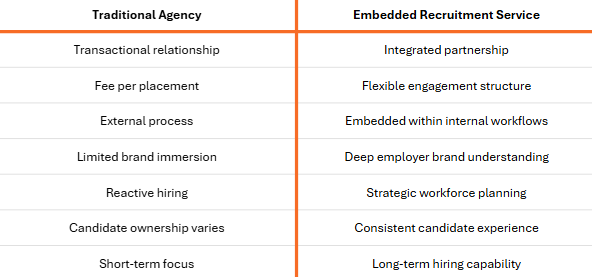
Embedded recruitment vs traditional recruitment agencies
Here’s where the differences become more obvious.
For many growing companies, embedded recruitment combines the best aspects of agency support and internal hiring.
The six questions every business should ask before choosing a recruitment partner
Not all recruitment solutions are equal. If you are evaluating an embedded recruitment service or comparing recruitment services more broadly, these six questions can help identify whether a provider is genuinely built for long-term growth.
1. How flexible is the recruitment model?
Can the provider scale support up and down as hiring demand changes? A strong flexible recruitment model should adapt to your business rather than forcing you into rigid contracts or fixed recruiter structures.
Look for:
Scalable recruiter capacity
Flexible engagement terms
Project-based support options
Ability to support multiple hiring volumes
2. Will recruiters operate as part of our business?
An embedded recruiter should feel like part of your team.
Ask:
Will they attend internal meetings?
Will they communicate using your systems?
Will they represent your employer brand directly?
How closely will they work with hiring managers?
Integration is often the biggest difference between effective embedded recruitment and traditional outsourcing.
3. How do they measure success?
Many recruitment providers still focus primarily on placements. A strategic embedded recruitment service should track broader hiring outcomes, including:
Time to hire
Quality of hire
Hiring manager satisfaction
Candidate experience
Offer acceptance rates
Diversity metrics
Pipeline health
Outcome-based hiring creates stronger long-term results.
4. What specialist hiring expertise do they offer?
Mid-sized companies often need support hiring difficult or niche roles. Ask whether the provider has experience in:
Technical recruitment
Executive hiring
Sector-specific talent markets
International hiring
Scaling teams quickly
A recruitment partner should bring expertise your internal team may not already have.
5. How transparent are their processes and reporting?
Visibility matters. A strong embedded recruitment partner should provide:
Clear reporting dashboards
Hiring funnel analytics
Pipeline visibility
Regular stakeholder updates
Market insights and benchmarking
Transparency improves hiring decisions and helps leadership teams forecast recruitment performance more accurately.
6. What happens when hiring slows down?
This is one of the most important questions many businesses forget to ask. If hiring demand changes, can the recruitment model adapt without leaving the business carrying unnecessary fixed costs? The best embedded recruitment services are designed to flex with business needs.
That scalability is particularly important for mid-sized companies navigating uncertain or fast-changing growth cycles.
Why embedded recruitment works particularly well for mid-sized companies
Enterprise businesses often have the scale to build large internal talent acquisition functions. Smaller businesses may rely entirely on founder-led hiring. But mid-sized companies sit in a more complex position.
They typically need:
Faster hiring than startups
More strategic recruitment support
Better hiring infrastructure
Specialist expertise
Greater scalability
More predictable recruitment costs
At the same time, they often do not want the fixed overhead of a large in-house recruitment department.
An embedded recruitment service fills that gap.
It allows businesses to access high-level recruitment capability without overbuilding internal teams too early.
The future of recruitment is hybrid
The companies hiring most effectively today are not choosing between agencies and internal recruiters.
They are building hybrid recruitment ecosystems.
That means:
Internal leadership alignment
Embedded recruitment expertise
Flexible hiring infrastructure
Specialist external support when needed
Scalable hiring operations
In practice, the future of recruitment is less about ownership and more about adaptability.
Businesses that can scale recruitment capability quickly, without sacrificing quality or candidate experience, will consistently outperform competitors in talent acquisition.
The traditional “agency vs in-house” hiring debate no longer reflects how modern businesses scale.
For many growing organisations, the smartest option is not choosing one or the other. It is adopting a flexible recruitment model that combines embedded expertise, scalability, operational alignment and strategic hiring support.
An embedded recruitment service gives mid-sized companies the ability to move faster, hire smarter, and scale more sustainably.
And as competition for talent continues to intensify, businesses that rethink their hiring structure now will be better positioned for long-term growth.
Need a more flexible way to scale hiring?
Talk to our team about building an embedded recruitment solution tailored to your growth plans, hiring challenges, and internal capability.
Santa.benga@VermeloRPO.com | 07304 094171
Or use our self-assessment tool:
FAQs
What is an embedded recruitment service?
An embedded recruitment service provides recruiters who work as part of your internal team while remaining externally managed. The model combines the integration of in-house recruitment with the scalability and expertise of an external recruitment partner.
How is embedded recruitment different from a recruitment agency?
An embedded recruiter operates within your business processes, employer brand, and hiring workflows. Traditional recruitment agencies usually work externally on a per-placement basis.
Why are flexible recruitment models becoming more popular?
Flexible recruitment models help businesses scale hiring support up or down depending on growth needs, making them more cost-effective and adaptable than fixed internal recruitment structures.
Is embedded recruitment suitable for mid-sized companies?
Yes. Embedded recruitment works particularly well for mid-sized company recruiting because it provides scalable hiring expertise without requiring a large permanent internal talent acquisition team.
What should companies compare when evaluating recruitment services?
Businesses should compare recruitment services based on scalability, integration, reporting transparency, specialist expertise, hiring outcomes, and flexibility.