
What are the best talent solutions for small businesses in the UK?
Small businesses win when hiring is simple, fast and repeatable. But UK SMEs face the same hiring pressures as large employers, without the time, the tooling or a dedicated recruitment team.
The right talent solution solves three problems at once: capacity (hands-on support without long-term headcount), quality (candidates who actually fit the role and the culture) and control (predictability around cost, process and compliance). Which solution does that for you depends almost entirely on how many people you're hiring and how predictably, so that's where to start.
First, be honest about volume
If you are making fewer than ten hires a year, a specialist agency may well be your best bet: you pay per hire, and there is not enough volume for a fixed monthly fee to beat that. If those hires are spread through the year and you would rather have one person who knows your business than a fee on each role, the same work can be run as a light embedded arrangement, a recruiter for a day or two a week, scaled to the plan. Either way, full RPO or an MSP is not the answer at that size.
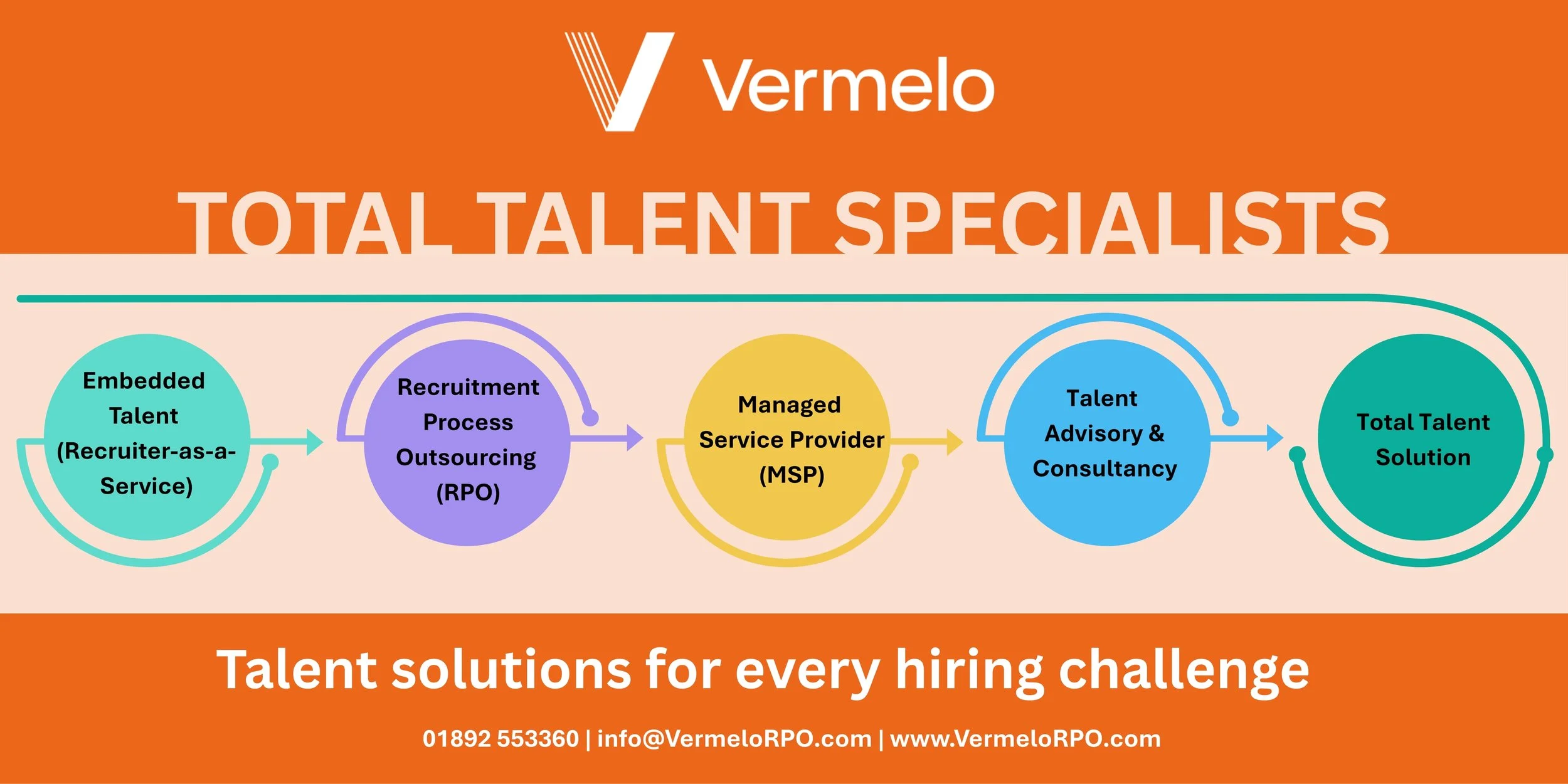
Embedded talent: a recruiter inside your business, without the permanent headcount
Embedded talent (Recruiter-as-a-Service) means a talent specialist, or a small team, joins your business for a defined period, working as part of your team, in your systems, in your brand voice and to your hiring priorities.
It's the best fit for SMEs that need consistent hiring support for one to six months or more, want a recruiter partnering directly with founders and heads of department, and are building a team that needs process and delivery, not just CVs. What it typically improves: faster role kick-off through tight briefs and realistic plans, a better candidate experience (a real differentiator for a smaller business), stronger collaboration with hiring managers, and cleaner pipelines with clear weekly reporting. You get the impact of in-house talent capability without committing to permanent headcount before you're ready.
Project RPO: a defined hiring burst, with an end date
Project RPO is a focused programme to deliver specific outcomes: "hire five customer support roles in six weeks" or "build a sales team this quarter". Best for seasonal hiring, funding-triggered growth, team launches, urgent backfills and "we need help right now" moments. You get predictable delivery through a defined process, structured screening that cuts hiring mistakes, proactive sourcing that shortens time-to-hire, and far less admin for founders and managers. It stops when the contract says it stops.
Full, ongoing RPO, where a provider runs your whole recruitment function, is a different proposition. It needs enough volume to justify a dedicated team and a management fee, and most small businesses aren't there yet. If you think you might be, our comparison of the eleven hiring models sets out where the line falls.
Talent advisory: make hiring easier before you post a role
Sometimes the biggest wins come from fixing the approach before delivery begins. Talent advisory helps you hire smarter, not just faster: role design (what you actually need versus what you wish you could hire), salary and market benchmarking, hiring process design (interview stages, scorecards, decision rules), employer brand and job advert optimisation, workforce planning (what to hire now versus later), and retention and onboarding improvements.
Best for SMEs struggling with low applicant quality, inconsistent interview decisions, high drop-off rates or repeat vacancies. It's also useful if you're not hiring yet: a process built now makes the next round of hiring faster and more successful.
When MSP and total talent come into it
If your business uses contractors and temps through several suppliers, an MSP brings supplier management, rate benchmarking, IR35 process and onboarding under one set of standards. It earns its keep once contractors span multiple suppliers or teams and nobody owns the full picture of spend, compliance and risk. Below that, a handful of contractors through one trusted agency doesn't need it yet. A total talent solution, which plans permanent and contingent hiring as one workforce, is usually the second model a client grows into rather than the first. Both are worth knowing about; neither is where most small businesses should start.
Quick match guide: which talent solution should you choose?
"We hire a handful of people a year" = a specialist recruitment agency, and a short supplier list
"We're hiring steadily and need ongoing support" = embedded talent
"We have a burst of roles to fill quickly" = project RPO
"Our hiring feels chaotic or unclear" = talent advisory
"We use contractors and temps across several suppliers" = MSP
"We're running permanent and contingent hiring as two separate worlds" = total talent
Many SMEs combine these: advisory to redesign the process, then project RPO to deliver the hires. Our Talent Solutions Finder will get you to a shortlist in a couple of minutes.
What good looks like
The right solution doesn't just provide candidates; it produces outcomes you can measure. For a UK SME that usually means shorter time-to-hire without sacrificing quality, higher-quality shortlists from better screening and clearer role profiles, more consistent hiring decisions through structured interviews and scorecards, an improved candidate experience with clear communication and fewer delays, better cost control with less wasted advertising and fewer mis-hires, and cleaner compliance and onboarding with right-to-work and documentation aligned.
Why smaller businesses work with Vermelo
Vermelo is built for businesses that need hiring to work without building a big internal function first: flexible delivery models you can move between as you grow, clear scope and timelines with minimal fuss, strategy and delivery joined up rather than sold as separate services, and the ability to start with one role and expand to a programme when the volume justifies it. And when the honest answer is "you don't need us yet", you'll hear that too.
If you're a UK SME looking to hire without the chaos, get in touch and we'll help you choose the model that's right for you.
Talent solutions for small businesses, answered
It depends on how many people you're hiring and how predictably. Fewer than ten a year, or a handful of specialist roles: a good specialist agency, and spend the effort choosing the consultant rather than the firm. Steady hiring you can't resource in-house: an embedded recruiter on a monthly engagement. A defined burst, such as a launch, a new contract or a funding round: project RPO with an end date. Hiring that feels chaotic before you've even posted a role: talent advisory first. Full RPO, MSP and total talent only start to pay for themselves at volumes most small businesses don't reach yet.
Project RPO is: a focused programme to deliver a defined set of hires by a date, then stop. Full, ongoing RPO usually isn't, because it needs enough volume to justify a dedicated team and a management fee. If your annual hiring fits on one hand, a tidy supplier list or an embedded recruiter will do the job for less. A good provider will tell you which camp you're in before you buy anything.
Then don't buy a programme. Use a specialist recruitment agency for the roles you can't fill yourself, keep the supplier list short enough that someone owns it, and put your energy into a clear brief and a fast, decent process. That's the honest answer, and it's the one you'll hear from us too, because our group includes a specialist agency for exactly that situation.
Vermelo is a UK talent solutions specialist delivering RPO, Project RPO, MSP, embedded talent (RaaS), total talent and talent advisory & consultancy. Named Best Recruitment Process Outsourcing (RPO) Business at the Global Recruiter Awards 2025. Part of the GWV Talent Solutions Group which includes Gerrard White Consulting and FlarePeople.